


The State of Foodservice in Convenience: Know Where to Grow
We examined that opportunity in our October 2 webinar, The State of Foodservice in Convenience, with The Food Institute. Our original consumer research and ingredient-level menu audit show where C-stores can compete for food-away-from-home dollars, and where manufacturers and distributors can help them grow.
Watch our webinar recap
Join MenuData’s Marie Molde, MBA, RD, and Jason Gunn for a closer look at the consumer demand, menu gaps, and pricing considerations shaping C-store foodservice. Watch the recap below, then use the findings to sharpen your next product or menu decision.
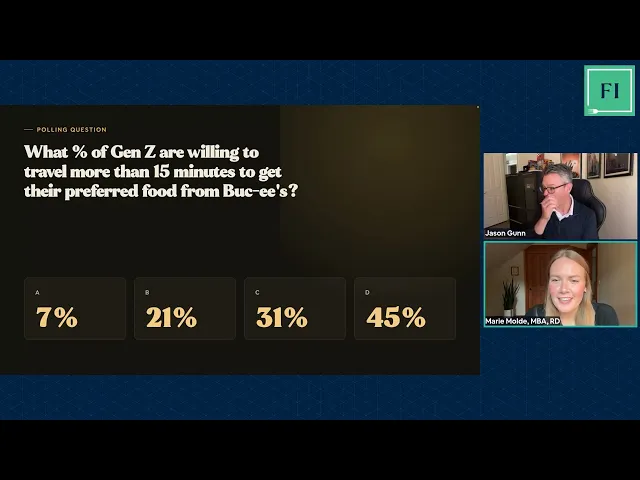
The State of Foodservice in Convenience. A MenuData webinar with The Food Institute.
Build the item shoppers will come back for
Buc-ee’s has brisket and barbecue. Casey’s has pizza. Wawa has hoagies and subs. Each gives shoppers a specific food association, and a reason to choose that store.
Our research puts a commercial consequence behind that choice. When we asked buyers what they would do if the signature item they came for was unavailable, 21% said they would skip the purchase entirely. The item that brings someone through the door needs to be ready when they arrive.
For operators, a signature item deserves priority in production planning and inventory. For suppliers, the opportunity is to help make that item dependable. Product consistency and preparation requirements belong in the sales conversation alongside flavor.
Improving an established favorite can also earn its place in the menu plan. Consider 7-Eleven’s focus on its pizza crust. Better execution of a core product gives shoppers a quality improvement they can experience across multiple varieties. A new topping is only one way to make a familiar item more appealing.
Find the white space at the ingredient level
We audited 650 prepared-food items across 11 C-store banners. All 11 offered sandwiches and wraps. Many sold similar categories of food, which makes the ingredients within those categories a useful place to look for distinction.
Hot honey appeared at only two of the banners we audited. In our chicken-sandwich comparison, however, buyers ages 18–34 preferred the hot honey option over the classic and chipotle versions.
That is the kind of white space we look for at MenuData. Consumer preference supports the flavor, and the menu audit identifies room to offer it within a familiar product. It gives an operator or supplier a specific idea to test, with evidence behind the choice.
Start with an item your customers already understand. A hot honey finish on a chicken sandwich is one option. Honey-harissa as a dip or gochujang in a sandwich spread could offer another route to new flavor. Those latter applications are ideas for testing; they were not established offers in our C-store audit.
The useful question is how a flavor fits your customer’s menu and operating requirements. A finishing sauce may create a distinctive item without adding a new preparation station or an entirely different food program.
Make the format work for the operator
A restaurant trend becomes a stronger C-store opportunity when the product fits the way the store serves food. Roller grills, holding equipment, and grab-and-go packaging all shape what an operator can sell reliably.
Buffalo chicken in a roller format and mac-and-cheese bites are examples of familiar foods adapted to that setting. Brisket in a breakfast taco gives an established ingredient another occasion. These formats let product teams rethink how an item is served and when a shopper might buy it.
There is an audience willing to try. In our survey, 30% of prepared-food buyers said they tried a new item on their last C-store visit. Among those buyers, 86% said they would buy it again. That is stated intent, rather than a measured repeat-purchase rate, but it gives operators a reason to test and track what happens after trial.
For manufacturers and distributors, the brief should be specific. Develop for the operator’s equipment, available labor, and holding requirements. Then measure whether the item earns a second purchase. A good first taste needs to translate into a product the store can serve consistently.
Protect the value shoppers already see
In our consumer research, 74% of buyers rated the value for money of their recent C-store prepared-food purchase as good or excellent. That is an advantage to protect as menus develop.
Our pricing analysis also compared C-store offers with quick-service restaurant items. A price difference can help inform a menu decision, but it does not establish how much more a shopper will pay. Quality expectations and price sensitivity still matter.
Test whether an additional flavor, a different portion, or a more convenient format earns its price. For a supplier, that means bringing an operator a product that fits both the menu and the economics of serving it. The opportunity is stronger when the store can execute the item reliably and shoppers consider it worth buying again
At MenuData, we connect consumer interest with what is actually on menus so teams can identify where to act. In convenience foodservice, that means looking closely at the signature item, the ingredient, and the format before committing to the next launch.
Research scope: Our consumer survey covered U.S. shoppers who had purchased prepared food at a convenience store in the previous 30 days. Menu findings reflect our 650-item, 11-banner audit, rather than every C-store menu.
Get the full State of Foodservice in Convenience report
Put the findings to work in your next C-store brief. Our full State of Foodservice in Convenience report brings together the consumer research, menu comparisons, flavor opportunities, and pricing analysis behind the webinar. Use it to identify where your menu or product portfolio has room to grow.